
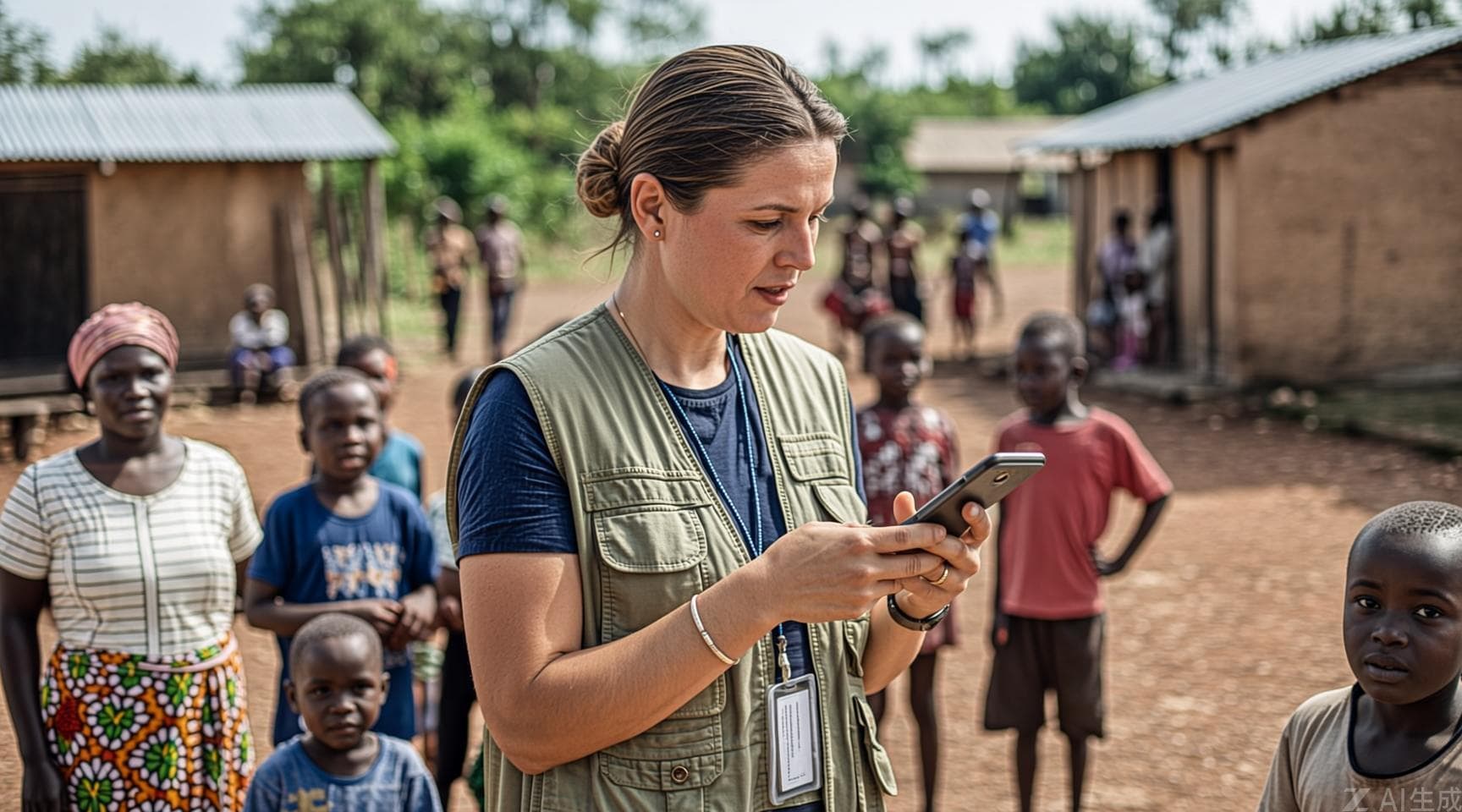
The assessment team is 50 kilometers from the nearest network connection. They have spent three days in a remote community, documenting household needs, tracking food security indicators, and mapping infrastructure damage. They have hundreds of observations, dozens of photographs, and critical information that needs to reach decision-makers.
When they finally reach a location with connectivity, they face a choice. They can spend the next 24 hours manually transcribing handwritten notes into databases, typing up observations from memory, and organizing scattered information. Or they can press Sync and watch three days of work upload in minutes, then immediately move on to the next community that needs assessment.
The difference is not just convenience. In humanitarian response, it is the difference between timely intervention and missed opportunities.
The Connectivity Gap in Humanitarian Work
Humanitarian operations by definition occur in places where infrastructure is limited or nonexistent. Conflict zones, disaster areas, and remote communities lack reliable network access. Yet the data systems used by humanitarian organizations increasingly assume constant connectivity.
The pattern is familiar. Assessment teams deploy to the field with paper forms or basic digital tools that assume network access. They collect valuable information about needs, vulnerabilities, and resources. Then they return to base and face the data entry bottleneck—hours or days of manual transcription, with all the errors and delays that manual processes introduce.
The problem is not just inefficiency. It is that by the time data is entered, cleaned, and analyzed, the situation on the ground has changed. The crisis has evolved. Needs have shifted. Opportunities for early intervention have passed. In humanitarian work, timely information is not just valuable—it is the difference between effective response and wasted resources.
How Offline-First Collection Works
The solution to the connectivity paradox is offline-first data capture. Assessment teams use systems that are designed from the ground up to work without network access, then synchronize seamlessly when connectivity becomes available.
During field work, team members capture observations using structured forms that work entirely offline. Voice notes transcribe automatically on the device. Photos are captured with timestamps and GPS coordinates. All data is stored locally, encrypted and organized, with no dependency on cloud connectivity.
More importantly, the system maintains context and relationships while offline. If multiple team members are assessing the same community, their devices consolidate information when they sync. If an assessment references a location, the system maintains that relationship offline. The result is a complete, structured dataset that does not depend on connectivity during collection.
When the team reaches a network connection, synchronization happens automatically. Upload happens in the background. No manual transcription is required. No data is lost in transfer. Within minutes of connectivity, decision-makers have access to complete assessment data that is ready for analysis and action.
The 72-Hour Standard
Why 72 hours? This is not an arbitrary number. It represents the practical maximum time that humanitarian teams can spend in the field before needing to sync data, based on battery life, storage capacity, and the operational tempo of humanitarian response.
A humanitarian organization responding to a natural disaster implemented offline-first collection with 72-hour offline capability. Their previous process used paper forms that were physically transported to base, then manually entered into databases. The typical delay between data collection and availability was four to six days.
After implementation, assessment teams could work in disconnected areas for up to three days, then sync immediately upon reaching any network connection. The average delay between collection and availability dropped to under 24 hours. Teams could spend more time in the field and less time on data entry. Decision-makers had current information rather than data that was nearly a week old.
The impact went beyond timeliness. Data quality improved because information was captured once, in structured forms, rather than transcribed from handwritten notes. Assessment teams could cover more area because they were not returning to base frequently for data transfer. The organization could make resource allocation decisions based on current needs rather than week-old assessments.
Making Offline Collection Practical
Implementing offline-first collection does not require changing your assessment methodologies or your data standards. The transformation begins with equipping teams with tools designed for disconnected environments.
The most effective implementation focuses on three elements. First, design assessment forms for offline use. The forms should work entirely on the device, with no dependency on server calls during data entry. Validation, dropdowns, and conditional logic should all function offline.
Second, implement automatic synchronization rather than manual data transfer. When a device connects to a network, sync should happen in the background without requiring user action. The system should handle conflicts intelligently—if multiple team members collected data about the same household, the system should consolidate rather than overwrite.
Third, establish the 72-hour offline capability as your standard. Test your systems to ensure they can function for three full days of intensive data collection without connectivity. Ensure devices have sufficient battery life and storage capacity. Your teams should never need to curtail field work because of data collection limitations.
The Humanitarian Impact
The connectivity gap in humanitarian work is not going away. Crisis zones will always lack infrastructure. Remote communities will always be disconnected from networks. The question is whether your data systems enable effective work in these environments or whether they create bottlenecks that slow response.
Offline-first collection is not just about efficiency. It is about reaching communities that would otherwise be underserved because assessment teams could not operate effectively in disconnected environments. It is about making decisions based on current realities rather than outdated information. It is about maximizing the time your teams spend in affected communities rather than on data entry.
Your assessment teams are already doing the hard work. They are traveling to remote areas, building trust, and gathering critical information. The question is whether your data systems amplify their effort or create friction that slows everything down.
Enable 72-hour offline data collection. Start a 14-day free trial and see the offline capabilities that 85+ NGOs use to work where connectivity does not exist.